
Recruiting, Training, and Retaining Effective Educators
Schools are only as effective as the teachers, administrators, and staff working within them. WEPC researchers seek to better understand the educator pipeline and to measure the impact of policies designed to improve the education workforce, from teacher preparation to professional development to increasing the diversity of the education profession.

Latest Projects

Understanding ECE Workforce Needs in Massachusetts
Author: Pia Caronongan Project Summary Expanding access to early care and education (ECE) in Massachusetts depends on having enough educators to staff it. This brief lays out a framework for estimating how many educators the state needs under different capacity expansion scenarios, accounting for licensing ratios, program setting, and annual turnover. Produced through WEPC's ongoing partnership with the Massachusetts Department of Early Education and Care (EEC), it applies that framework to an...

Teacher Shortages in Connecticut
Project Summary The Wheelock Educational Policy Center, in partnership with the Connecticut State Department of Education, tracks where and why staffing shortages persist in Connecticut's public schools. These reports identify shortage areas across special populations, general education subjects, and school support personnel—and examine how those gaps fall unevenly across districts. Together, the 2023 and 2025 editions show how the state's staffing challenges have evolved over time.Project...

Guardrails or Barriers
How changes afoot in teacher licensure could help settle decades-long debates Change is afoot with teacher licensure. In almost every state we know of, there is a conversation happening about the requirements that determine who can become a teacher. But not all states are moving in the same direction. The shifting sands of teacher licensure offer a good opportunity to revisit old debates about the efficacy of licensure requirements and highlight a significant problem: the current state of...
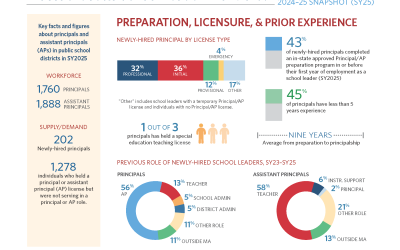
Massachusetts School Leader Workforce – Annual Snapshots
Project Resources Working Paper (March 2026) 2025-2026In the News Project Summary Led by Dr. Olivia Chi, WEPC is partnering with the Massachusetts Department of Elementary and Secondary Education to study the characteristics, career trajectories, and outcomes of principals and assistant principals in public schools. These snapshots illustrate key facts and figures about the Massachusetts school leader workforce in multiple school years, providing policy-relevant insights for the...

Examining Wage Growth in ECE Programs: Evidence from Massachusetts
Authors: Pia Caronongan, Katie Hyland Project Summary Early educators are among the lowest-paid workers in the United States, in part because most early care and education (ECE) programs operate within constrained business models. In Massachusetts, the Commonwealth Cares for Children (C3) program distributes grants that can be used for workforce investments. We examined how educator wages changed during the program’s implementation and what factors explain variation in wage growth. Average...
Assessing the Potential Impact of Seniority-Based Reduction in Force Policies on the Changing Teacher Workforce in Connecticut Schools
Project Summary Over the last decade, policymakers and education leaders in Connecticut have prioritized efforts to improve the quality and diversity of the teacher workforce. Persistent focus and targeted investments in strong teacher pipelines have helped increase teacher diversity from 8% in 2014 to 12% of the workforce identifying as teachers of color in 2024. Through a research partnership with the Wheelock Educational Policy Center (WEPC) at Boston University, the Connecticut State...

Early Education Workforce Supports at Scale
How state-level data and research could improve innovations and investments in Massachusetts Recognizing the critical role and economic necessity of high-quality early childhood educator (ECE) workforce, Massachusetts has made substantial investments in the development and retention of the ECE workforce in recent years. And while the state is working to monitor these efforts through additional data collection, the state continues to lack foundational insights and a comprehensive...

Forecasting the Supply and Demand of Diverse Educators
Authors: Andrew Bacher-Hicks, Olivia Chi Project Summary The increasing diversity of students in Massachusetts makes growing a diverse educator workforce a critical policy goal for the Commonwealth. In recent years, state and local leaders have responded to this challenge with a variety of programs and policy changes. This report details these efforts and their considerable impact to date. However, the findings show the racial and ethnic differences between the state’s students and teachers...

Comparing Turnover Intentions and Actual Turnover in the Public Sector Workforce
Authors: Tuan D. Nguyen, Elizabeth Bettini, Christopher Redding, Allison F. Gilmour Project Summary When teachers choose to leave their jobs, it can be disruptive and costly for their school and district, affecting everything from student learning to the experiences of other teachers and staff. For this reason, policymakers have been worried by indications that many teachers are thinking about leaving the profession. But just how reliable are these warning signs that teachers are thinking of...