
Equalizing Educational Opportunity
Disparities in student opportunities and outcomes from kindergarten through higher education are shaped by a complex set of school, community, governance, and non-education sector factors. WEPC researchers evaluate the impact of policies and practices both within and outside of schools on student educational and life outcomes.

Latest Projects
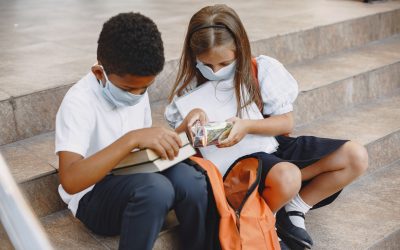
Air Pollution and Learning
Authors: A. Patrick Behrer, Joshua Goodman, J. Parker Goyer, R. Jisung Park Project Summary Air pollution is usually treated as a public health and environmental concern, but it can also affect how much students learn. This brief summarizes a new study of how exposure to polluted air over a school year affects student learning, when that exposure matters most, and which students bear the greatest cost. The authors draw on College Board data for nearly 10 million students who took the PSAT at...
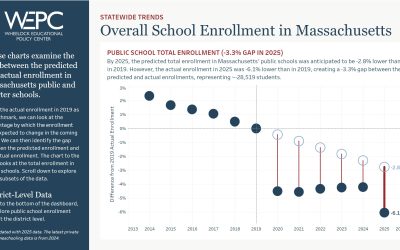
Massachusetts School Enrollment Dashboard
This interactive dashboard examines the gap between the predicted and actual enrollment in Massachusetts public, private, charter, and home schools.
Special Education Substantially Improves Learning: Evidence from Three States
Authors: Stephanie Coffey, Joshua Goodman, Amy Ellen Schwartz, Leanna Stiefel, Marcus A. Winters, Yunee H. Yoon Project Summary Special education serves more than one in seven U.S. students, yet its causal impact remains understudied. In this paper, we estimate the effect of individualized supports with an event-study design that tracks achievement around initial classification. The research shows students’ scores decline prior to placement and rise sharply afterward. Overall, individualized...
Early Returns: Reversing Enrollment Declines in Massachusetts Community Colleges through MassReconnect
Authors: Shaun Dougherty, Morgan Fleming, Joshua Goodman, Yunee H. Yoon Project Summary When Massachusetts introduced MassReconnect in 2023, it aimed to reverse a decade of community college enrollment decline by offering free tuition to adults 25 and older. Early results prompted the state to expand the program to all residents through MassEducate, representing a substantial state investment in expanding access. This report analyzes MassReconnect's first two years, exploring enrollment...

Declining Community College Enrollment & Labor Market Strength
Authors: Joshua Goodman and Joseph Winkleman Project Summary Declining U.S. college enrollments have triggered questions about the health of the postsecondary sector. This project examines national data collected through the Department of Education's Institute for Education Sciences to better understand shifts in the sector and help situate trends within the context of broader economic and labor market context. These findings have important implications for policy discussions about higher...

School Enrollment Shifts Five Years After the Pandemic
Authors: Abigail Francis, Joshua Goodman Project Summary When school doors closed in March 2020, many anticipated this disruption would have long-term effects on students. Nonetheless, a common assumption throughout this period was that students would eventually return to school. Five years post-pandemic, we are witnessing a more dramatic shift in the composition and enrollment of public schools than expected. This research documents the changes in public school enrollment in one state and...

English Learners’ Access to Massachusetts Early College Programs
Authors: Yasuko Kanno, Andrew Bacher-Hicks, Pierre Lucien Project Summary Early college programs (ECPs) are an increasingly common approach for promoting college enrollment and degree/credential completion, particularly for historically marginalized students. In Massachusetts, ECPs launched in 2017 and have since scaled rapidly. To better understand whether English learners (ELs) are taking advantage of these promising programs, the authors of this study examined the extent to which ELs are...

Who Benefits from Remote Schooling?
Authors: Jesse Bruhn, Christopher Campos, Eric Chyn Project Summary At the onset of the COVID-19 pandemic, school districts around the country quickly transitioned to providing full- or part-time remote learning options for students who had otherwise been attending school completely in person. These unusual and unprecedented circumstances meant that families suddenly had an opportunity to assess the suitability of remote learning for their children over an extended time. Although there is...

The Stickiness of Pandemic-Driven Disenrollment from Public Schools
Authors: Andrew Bacher-Hicks, Tareena Musaddiq, Joshua Goodman, & Kevin Stange This reflects joint work with colleagues at the Education Policy Initiative at the University of Michigan's Ford School of Public Policy. Project Summary This study builds upon the authors’ prior research on enrollment shifts across school sectors during the first year of the COVID-19 pandemic and examines whether these patterns persisted into the subsequent school year. The authors use longitudinal...