
Research
In partnership with state and local education agencies, education service providers, and non-profit organizations, WEPC researchers study the efficacy of educational policies and practices in order to improve opportunities and holistic outcomes for traditionally marginalized students. WEPC’s research areas are concerned with equalizing educational opportunity. studying the efficacy of specialized services, and progressing the education workforce.

Research Areas
Equalizing Educational Opportunity
Disparities in student opportunities and outcomes from kindergarten through higher education are shaped by a complex set of school, community, governance, and non-education sector factors. WEPC researchers evaluate the impact of policies and practices both within and outside of schools on student educational and life outcomes.
Specialized Services
In many cases, students with specialized needs, such as English language learners and students with disabilities, are not receiving the supports they need to succeed academically. WEPC researchers leverage large-scale administrative datasets and rigorous causal research designs to evaluate the efficacy of policies and commonly used practices targeted for these students who benefit from targeted supports.
Effective Educators
Schools are only as effective as the teachers, administrators, and staff working within them. WEPC researchers seek to better understand the educator pipeline and to measure the impact of policies designed to improve the education workforce, from teacher preparation to professional development to increasing the diversity of the education profession.
Featured Papers

Understanding ECE Workforce Needs in Massachusetts
Author: Pia Caronongan Project Summary Expanding access to early care and education (ECE) in Massachusetts depends on having enough educators to staff it. This brief lays out a framework for estimating how many educators the state needs under different capacity expansion scenarios, accounting for licensing ratios, program setting, and annual turnover. Produced through WEPC's ongoing partnership with the Massachusetts Department of Early Education and Care (EEC), it applies that framework to an...
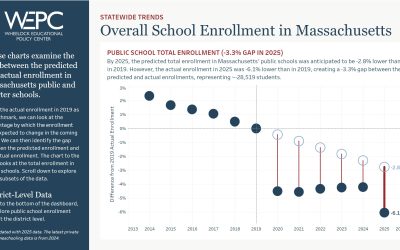
Massachusetts School Enrollment Dashboard
This interactive dashboard examines the gap between the predicted and actual enrollment in Massachusetts public, private, charter, and home schools.

Teacher Shortages in Connecticut
Project Summary The Wheelock Educational Policy Center, in partnership with the Connecticut State Department of Education, tracks where and why staffing shortages persist in Connecticut's public schools. These reports identify shortage areas across special populations, general education subjects, and school support personnel—and examine how those gaps fall unevenly across districts. Together, the 2023 and 2025 editions show how the state's staffing challenges have evolved over time.Project...